Physical Wake
The target laptop reaches the opt-in wake diagnostic, receives built-in keyboard bytes, and accepts wake + Enter.
Current checked-in boundary: Phase 13 -> Phase 13.5
A from-scratch, verification-driven x86-64 operating system that boots
through UEFI, runs a capability-controlled ring-3 object shell, and
persists typed/versioned objects across verified storage backends.
Current main records the Phase 12 object-locator
decision and resolver, Phase 13 local package lifecycle, the accepted
PythTIG Phase 7 cutover/cross-target line, and an opt-in physical wake
diagnostic verified on the target laptop.
2026-08-26 physical acceptance
A physical boot on the target laptop reached the PythOS wake
diagnostic, accepted input from the built-in keyboard, decoded the
exact wake plus Enter sequence, and displayed
accepted on the framebuffer.
Observed raw Set-1 bytes 11 91 1E 9E 25 A5 12 92 1C
This proves the post-firmware keyboard byte path and wake recognizer on this physical machine. It does not claim generic PC input, USB HID, trackpad support, interrupt-driven keyboard input, or a general login/shell surface.
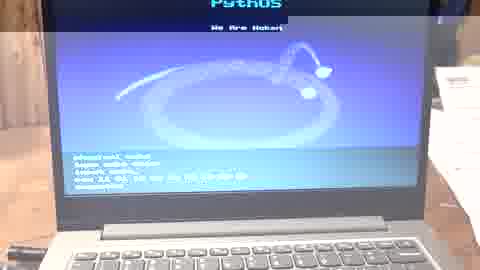
wake + Enter accepted from the built-in keyboard.
Milestone 1.5 and Phases 2 through 10 are complete through
PYTHOS:CORE:PHASE_10_COMPLETE. Phase 11 findings are
recorded through ADR 0046. PythTIG Phase 1 through Phase 7 are
merged to main. Phase 12 is complete through ADR
0069, ADR 0070, ADR 0072, and
PYTHOS:CORE:PHASE_12_COMPLETE. Phase 13 is complete
through ADR 0073 and PYTHOS:CORE:PHASE_13_COMPLETE.
Kernel path UEFI loader to PythCore native executive to ring-3 shell and object persistence.
Graph path ADR 0064/0065/0068 PythTIG packages, verifier, runtime, compiler, Task Steward, native backend, and cutover evidence.
Locator path ADR 0069 chooses capability-scoped object locators rather than POSIX paths; ADR 0070 and ADR 0072 record resolver and adversarial evidence.
Physical evidence O2 Micro 1217:8620 terminal capture: count 00000139 = 313 decimal markers, drop 00000000, crc 176F4C6E.
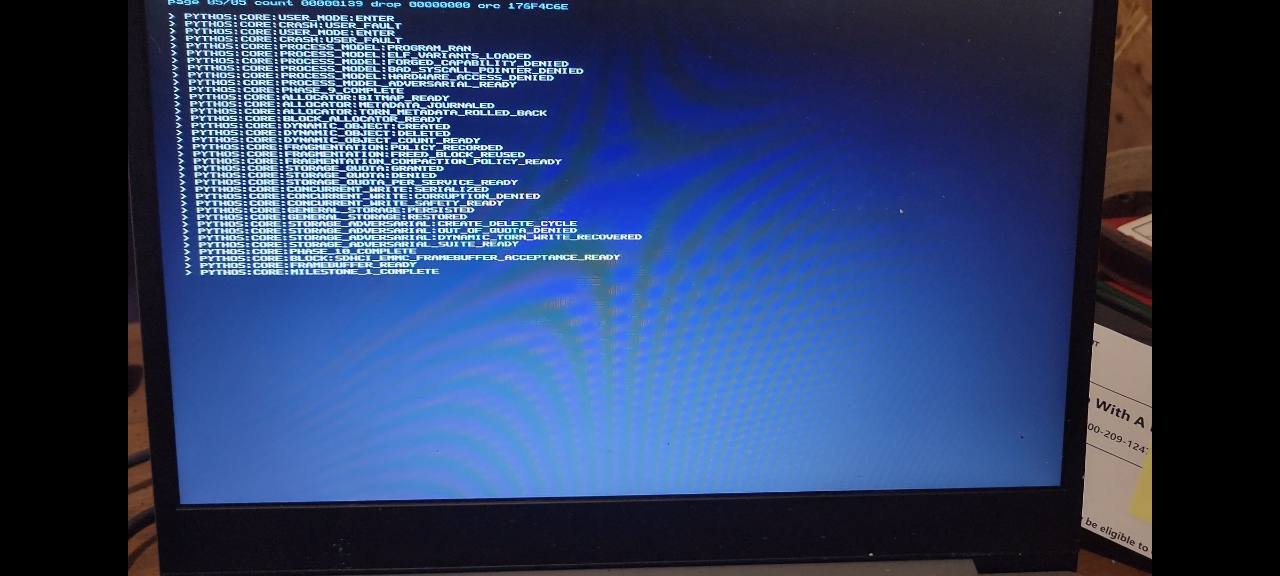
Evidence terminal
The terminal status formatter renders count, drop, and CRC as
eight-digit hexadecimal fields. The captured physical Phase 10 path
therefore contains 313 ordered markers, not 139: 00000139
hex equals 313 decimal. Two separate physical boots produced the same
count, zero-drop state, and CRC 176F4C6E. The physical
marker stream differs from QEMU only where truthful hardware discovery,
audio fallback, and pre-existing persistent-storage state select
different marker branches; the reconstructed physical stream recomputes
to the displayed count and CRC.
These markers are acceptance evidence for the captured milestone path. They are not a claim that every named subsystem is production-complete, portable, interrupt-driven, or broadly supported across hardware. CRC-32 repeatability is strong reproducibility evidence, not a collision-proof identity proof.
The target laptop reaches the opt-in wake diagnostic, receives built-in keyboard bytes, and accepts wake + Enter.
ADR 0073 records the local package lifecycle and schema extensibility proof. Phase 13.5, persistent Pyth sessions, Kai/Waking, networking, and later phases remain gated.
The stable milestone page records hardware identity, exact markers, physical artifacts, QEMU acceptance commands, and scope boundary.
The PythTIG docs record the accepted graph-package, verifier, runtime, compiler, native backend, Task Steward, and cross-target gates.